
Running a successful Shopify store requires constant content creation. Product descriptions, blog posts, category pages, buying guides, and FAQ content all compete for your attention. Yet most store owners struggle to maintain consistent content output while managing inventory, customer service, and operations.
Content automation solves this problem. By strategically implementing AI-powered content workflows, you can produce SEO-optimized content at scale without sacrificing quality or authenticity.
Why Shopify Stores Need Content Automation
E-commerce SEO demands volume. To compete for organic traffic, your store needs:
- Comprehensive product descriptions for every item
- Category page content that targets commercial keywords
- Blog posts that capture informational search intent
- Buying guides that establish topical authority
- FAQ content that addresses customer questions
Creating all this content manually is impractical for most Shopify stores. A single product description might take 30-60 minutes when done well. A comprehensive buying guide could consume an entire day.
Content automation changes this equation. Instead of writing from scratch, you generate first drafts in minutes, then refine them to match your brand voice. This approach multiplies your output while maintaining quality.
For a detailed breakdown of how automation fits into Shopify SEO strategy, our comprehensive guide covers the fundamentals.
The Shopify Content Automation Stack
Building an effective automation system requires the right tools and workflows. Here's how to assemble your stack.
AI Content Generation
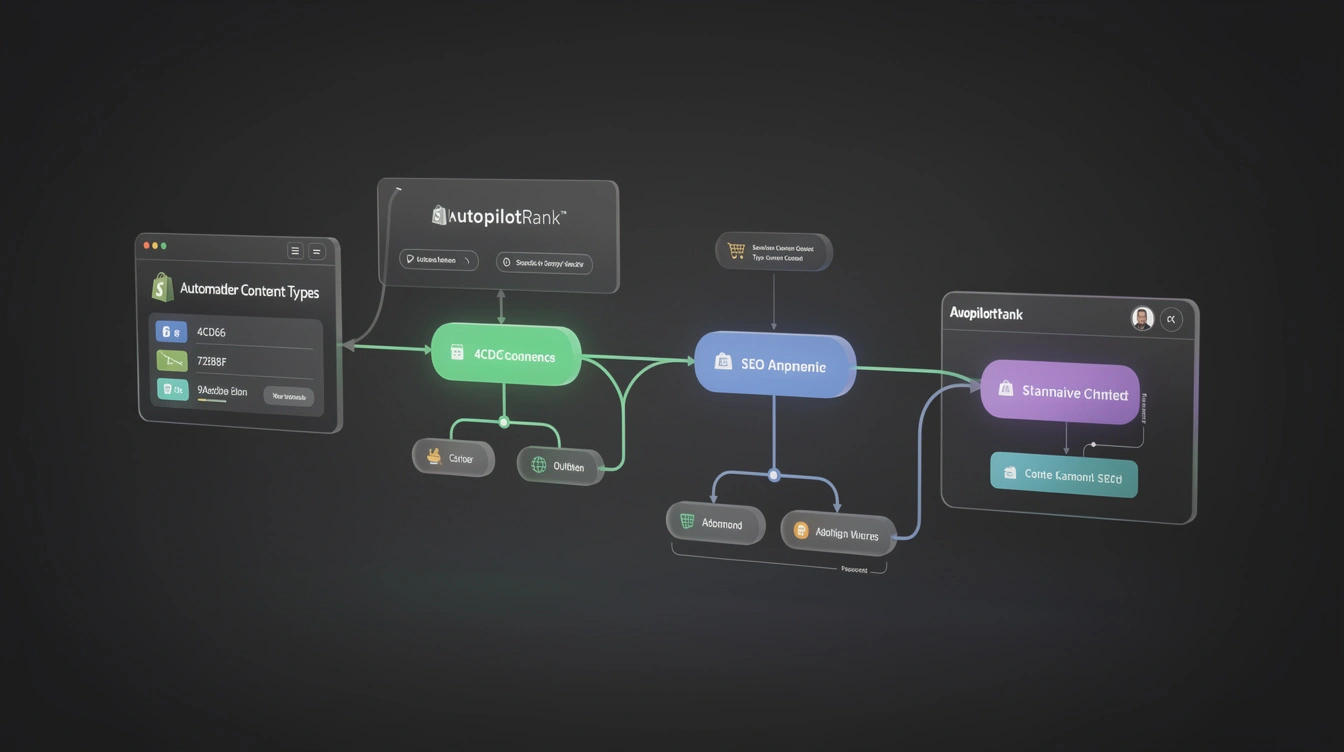
The foundation of content automation is AI-powered writing assistance. Platforms like AutopilotRank generate SEO-optimized content using multiple AI models, then humanize the output to sound natural and read naturally.
Key capabilities to look for:
- Multi-model AI access: Different models excel at different content types
- Built-in humanization: Automatic refinement that makes AI content sound natural
- SEO optimization: Content structured for search rankings out of the box
- Brand voice customization: Consistency with your existing tone and style
Content Planning and Research
Automation extends beyond writing. AI-powered research tools help identify:
- High-value keywords in your niche
- Content gaps in your existing coverage
- Competitor content strategies
- Trending topics in your market
This research informs your content calendar, ensuring you create content that actually drives traffic.
Publishing Integration
The most efficient workflows connect content creation directly to your Shopify store. Look for:
- Direct publishing to Shopify blogs
- Bulk content upload capabilities
- Template systems for consistent formatting
- Scheduling features for content planning
Our Shopify blog automation guide walks through setting up these integrations step by step.

Content Types Perfect for Automation
Not all content benefits equally from automation. Focus your efforts on these high-impact areas.
Product Descriptions
Product pages are your primary conversion points. AI excels at creating consistent, SEO-optimized descriptions that highlight key features and benefits.
Automation approach:
- Create templates for different product categories
- Feed product specifications and key selling points to AI
- Generate descriptions with SEO keywords included
- Review and refine for brand voice accuracy
- Publish directly to product pages
This approach reduces product description creation time from hours to minutes per item.
Blog Content
Blog posts drive organic traffic and establish topical authority. AI handles the heavy lifting of research and drafting.
Content types that work well:
- How-to guides: Step-by-step instructions for using products
- Comparison posts: Matching products to customer needs
- Buying guides: Educational content for purchase decisions
- Industry news: Commentary on trends and developments
- Product showcases: Deep dives into featured items
The key is maintaining editorial oversight. AI generates comprehensive drafts, but human review ensures accuracy and brand alignment.
Category Page Content
Category pages often lack the substantive content needed to rank well. AI can generate introductory content, buying advice, and category explanations that improve SEO performance.
Structure category content to:
- Explain what the category includes
- Address common customer questions
- Provide selection guidance
- Include relevant keywords naturally
FAQ Content
FAQ pages capture long-tail search traffic and improve customer experience. AI excels at generating comprehensive FAQ content based on:
- Customer service logs
- Product reviews and questions
- Industry knowledge
- Competitor FAQ analysis
Building Your Automation Workflow
Success with content automation requires a systematic approach. Here's how to build an effective workflow.
Step 1: Audit Existing Content
Before automating, understand your current content landscape:
- Which pages perform best organically?
- Where are the content gaps?
- What keywords are you missing?
- Which competitors are winning on content?
This audit informs your automation priorities.
Step 2: Define Content Templates
Templates ensure consistency across automated content. Create structures for:
- Product description formats
- Blog post outlines
- Category page layouts
- FAQ formatting
Templates guide AI generation and reduce editing time.
Step 3: Establish Quality Standards
Automated content still needs quality control. Define standards for:
- Minimum word counts by content type
- Required elements (headings, internal links, CTAs)
- Brand voice guidelines
- Accuracy verification procedures
Step 4: Build a Content Calendar
Plan your automated content production:
- Product launches requiring new descriptions
- Seasonal content needs
- Blog post topics by month
- Category page updates
A calendar ensures consistent output and strategic coverage.
Step 5: Implement Review Workflows
AI-generated content benefits from human review:
- Fact-checking for accuracy
- Brand voice alignment
- SEO optimization verification
- Link quality and relevance
Build review time into your workflow.
Measuring Automation Success
Track these metrics to evaluate your content automation ROI:
Organic Traffic Growth: Monitor increases in organic sessions to automated content pages.
Keyword Rankings: Track position improvements for target keywords.
Content Velocity: Measure how much content you produce per month compared to pre-automation.
Time Savings: Calculate hours saved on content creation tasks.
Conversion Rates: Ensure automated content converts at similar rates to manually created content.
Common Automation Mistakes
Avoid these pitfalls when implementing content automation:
Publishing Without Review
Raw AI output isn't publication-ready. Always review for accuracy, brand voice, and quality before publishing.
Ignoring Brand Voice
AI content can sound generic. Customize prompts and templates to match your unique voice and style.
Over-Optimizing for SEO
Keyword stuffing hurts rankings. Ensure automated content reads naturally while including relevant terms.
Neglecting Updates
Automated content needs maintenance. Schedule regular reviews to update statistics, refresh examples, and maintain relevance.
Creating Duplicate Content
Each piece of content should offer unique value. Avoid generating multiple pages targeting identical keywords with similar content.
Advanced Automation Strategies
Once you've mastered basic automation, explore these advanced approaches.
Dynamic Content Generation
Use customer data to personalize content:
- Location-specific product recommendations
- Behavior-triggered content suggestions
- Seasonal content adaptation
Content Refresh Automation
Automatically identify and update aging content:
- Monitor content performance decay
- Flag pages for updates based on age
- Generate refreshed versions for review
Multi-Language Expansion
Scale into new markets with automated translation and localization:
- Generate content in multiple languages
- Adapt messaging for regional preferences
- Maintain consistency across language versions
Getting Started with Shopify Content Automation
Ready to scale your store's content? Begin with these steps:
- Identify your highest-impact content needs
- Choose an AI content platform with Shopify integration
- Create templates for your primary content types
- Start with a pilot project (e.g., product descriptions)
- Measure results and expand to additional content types
For comprehensive guidance on implementing Shopify blog automation, our detailed walkthrough covers the entire process from setup to scale.
Content automation transforms how Shopify stores approach SEO. By producing consistent, high-quality content at scale, you can compete with larger competitors and capture organic traffic that drives sustainable growth.
Ready to automate your Shopify content strategy? View our pricing plans to find the right fit for your store's needs.
The most successful Shopify stores in 2026 leverage automation without sacrificing authenticity. The key is using AI as a powerful assistant while maintaining the human touch that builds customer trust.
Reviewed for SEO operators

Joao Furtado
Founder & SEO Automation Specialist
Joao Furtado builds and operates SEO automation systems — from keyword research and multi-model drafting to quality scoring, CMS publishing, and Google Search Console optimization.
Articles are reviewed against real production workflows: keyword selection, draft generation, quality scoring, CMS publishing, and post-publication optimization.
Related Reading
Guides
WordPress SEO Automation 2026: Scale Content Without Writers
Learn how to auto-publish AI SEO content on WordPress with a schedule. Setup steps, real time savings, and how it compares to manual content creation.
7 min read
Guides
AI Content vs Human Content for SEO: When to Use Each (2026)
Compare AI content vs human content for SEO success. Learn the strengths of each approach and when to deploy them for maximum search visibility.
8 min read
Guides
Automated Backlink Building: Tools & Strategies for 2026
Master automated backlink building with proven strategies. Learn which tactics work, which to avoid, and how to scale link acquisition safely.
10 min read
Share this article